 English
 Svenska
Roaring 21
Like blackjack?
We’ll double your first deposit up to $1,000 free
Focus here: mathematically correct blackjack basic strategy—how to use hard-total, soft-total and pair charts, and how the decisions change when the table rules change.
New to the game itself? Begin with our blackjack rules guide. For a compact printable reference, use the blackjack strategy cheat sheet.
Blackjack basic strategy is the mathematically best hit, stand, double, split or surrender decision for each player hand against each dealer upcard under a defined set of rules.
It does not predict the next card and does not guarantee that a hand will win. It chooses the action with the highest expected value—or the smallest expected loss—when the same situation is repeated many times.
There is no single chart that is perfectly correct for every blackjack table. Strategy can change with:
- The number of decks
- Whether the dealer stands or hits soft 17
- Whether doubling after splitting is allowed
- Which starting totals may be doubled
- Surrender availability
- American peek or European no-hole-card dealing
- Original-bets-only protection
- Pair-resplitting and ace rules
- Special rules such as a five-card or six-card Charlie
The three charts on this page use one consistent reference game:
- Four to eight decks
- Dealer stands on soft 17, abbreviated S17
- Double after split allowed, abbreviated DAS
- Late surrender available
- American hole-card and peek procedure
- Blackjack pays 3:2
Later sections explain the important changes for H17, no DAS, no surrender, single deck and European no-hole-card blackjack.
Blackjack basic strategy at a glance
| Question | Direct answer |
|---|---|
| What is basic strategy? | The highest-expected-value playing decision for a given hand, dealer upcard and rule set. |
| Does it guarantee a win? | No. It improves long-run expectation but cannot control short-term card outcomes. |
| Is one chart correct everywhere? | No. Deck count, S17/H17, DAS, surrender and hole-card procedures can change individual cells. |
| Which chart should be checked first? | Surrender first when available, then pairs, then soft hands, then hard totals. |
| Should insurance be taken? | Not under ordinary basic strategy. Insurance is a separate wager with negative expectation for a non-counter. |
| Does bet size change the correct play? | No. A $5 and $500 hand use the same strategy when the cards and rules are identical. |
| Does a losing streak change the chart? | No. Previous wins and losses do not change the mathematically correct action. |
| Can card counters deviate? | Yes. Count-based indices can change selected plays after basic strategy is mastered. |
Basic strategy does not produce one fixed house edge
The statement that basic strategy always reduces the house edge to exactly 0.5% is too broad.
The final house edge depends on the complete game. With competitive 3:2 rules, accurate strategy can often bring the house advantage into roughly the one-half-percent range, but some games are lower and others substantially higher.
Basic strategy cannot repair every weak rule.
For example:
- A 6:5 blackjack payout adds approximately 1.39 percentage points to the house advantage compared with 3:2.
- Dealer hitting soft 17 costs the player approximately 0.22 percentage points compared with S17.
- Prohibiting double after split costs approximately 0.14 percentage points.
- Restricting doubles to 10 and 11 costs approximately 0.18 percentage points compared with doubling any first two cards.
- European no-hole-card exposure can cost approximately 0.11 percentage points when additional split and double wagers lose to dealer blackjack.
Those figures are approximate rule effects under standard comparison assumptions. They are not added blindly to every casino game. Use a complete rule-specific house-edge calculator when exact precision is required.
Correcting the old “house edge ladder” explanation
The former page claimed that the casino begins with an 8% edge, that the 3:2 payout reduces it to 5.7%, hitting and standing reduce it to 2.5%, doubling reduces it to 1%, and splitting brings it below 0.5%.
That is not how blackjack house edge is normally calculated.
The game’s expected return is determined by evaluating all possible outcomes under the complete rules and player strategy. Hitting, standing, doubling and splitting are interdependent options, not independent discounts applied one after another.
A better explanation is:
- The rules establish the set of legal actions and payouts.
- The probability and expected value of each available action are calculated.
- Basic strategy selects the best action in every decision state.
- The weighted result across all starting hands produces the game’s overall expected return.
This is why a strategy chart must match the actual rules.
How to read a blackjack basic strategy chart
The player’s hand appears down the left side. The dealer’s visible upcard appears across the top.
Find the intersection of the two and follow the action code.
| Code | Action |
|---|---|
| H | Hit. |
| S | Stand. |
| D/H | Double if allowed; otherwise hit. |
| D/S | Double if allowed; otherwise stand. |
| P | Split the pair. |
| R/H | Surrender if allowed; otherwise hit. |
The correct order of decisions
Do not begin by adding the cards and immediately opening the hard-total chart.
Use this order:
- Check surrender. Surrender is normally available only on the original two-card hand and must be considered before hitting, splitting or doubling.
- Check pairs. When the first two cards have the same rank, consult the pair chart.
- Check soft totals. When an ace can count as 11 without busting, use the soft chart.
- Use the hard-total chart. All remaining hands are hard totals.
Example: pair of 5s
Two 5s are a pair, so check the pair chart first. The chart does not split them. It treats the cards as hard 10, which is doubled against dealer 2 through 9 under the reference rules.
Example: ace-7
Ace-7 is soft 18 because the ace can count as 11. Use the soft chart, not the hard-18 row.
Example: ace-7-10
The ace can no longer remain 11 because that would total 28. It becomes 1, creating hard 18. Use the hard-total chart and stand.
Hard-hand basic strategy chart
A hard hand either contains no ace or contains an ace that must count as 1 to avoid busting.
Examples include:
- 10-6: hard 16
- 9-7: hard 16
- A-5-10: hard 16
- 10-7: hard 17
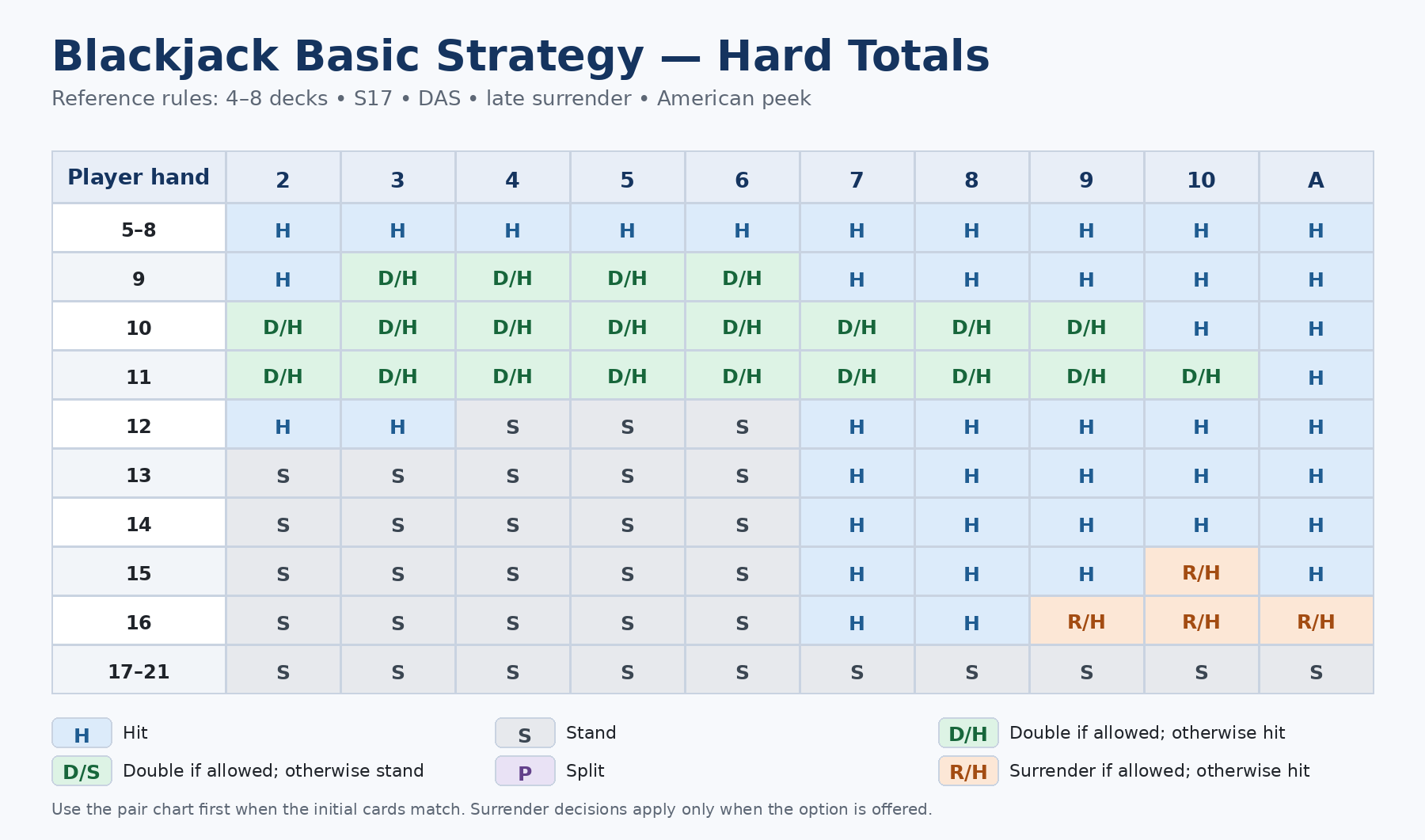
| Player hand | 2 | 3 | 4 | 5 | 6 | 7 | 8 | 9 | 10 | A |
|---|---|---|---|---|---|---|---|---|---|---|
| 5–8 | H | H | H | H | H | H | H | H | H | H |
| 9 | H | D/H | D/H | D/H | D/H | H | H | H | H | H |
| 10 | D/H | D/H | D/H | D/H | D/H | D/H | D/H | D/H | H | H |
| 11 | D/H | D/H | D/H | D/H | D/H | D/H | D/H | D/H | D/H | H |
| 12 | H | H | S | S | S | H | H | H | H | H |
| 13 | S | S | S | S | S | H | H | H | H | H |
| 14 | S | S | S | S | S | H | H | H | H | H |
| 15 | S | S | S | S | S | H | H | H | R/H | H |
| 16 | S | S | S | S | S | H | H | R/H | R/H | R/H |
| 17–21 | S | S | S | S | S | S | S | S | S | S |
Hard-total strategy explained
Hard 5 through 8
Hit. The total is too low to stand, and the reference multi-deck chart does not double hard 8.
Hard 9
Double against dealer 3 through 6. Hit against 2 and 7 through ace.
Hard 10
Double against dealer 2 through 9. Hit against 10 or ace.
Hard 11
Double against dealer 2 through 10. Hit against an ace under the reference S17 rules.
When the dealer hits soft 17, doubling 11 against an ace becomes correct.
Hard 12
Stand against dealer 4, 5 or 6. Hit against 2, 3 and 7 through ace.
This is one of the most frequently misplayed rows. Dealer 2 and 3 are not strong enough bust upcards to justify standing with hard 12 under ordinary total-dependent strategy.
Hard 13 through 16
Stand against dealer 2 through 6. Hit against 7 or 8.
When surrender is available:
- Surrender hard 15 against dealer 10.
- Surrender hard 16 against dealer 9, 10 or ace.
If surrender is unavailable, hit those hands.
Hard 17 or more
Stand. The risk of busting outweighs the possible improvement from another card.
Do not “always assume the dealer has a ten”
The old article repeatedly explained strategy by pretending that the dealer’s hidden card is always worth ten.
Ten-value cards are common, but basic strategy does not assume one specific hole card. It evaluates every possible dealer hole card and subsequent draw, weighted by probability.
The “assume a ten” shortcut can occasionally make a decision feel intuitive, but it produces incorrect reasoning in many close situations.
Use the chart, not an invented hole card.
Soft-hand basic strategy chart
A hand is soft when it contains an ace that can currently count as 11 without making the total exceed 21.
Examples:
- A-2: soft 13
- A-6: soft 17
- A-7: soft 18
- A-A-5: soft 17

| Player hand | 2 | 3 | 4 | 5 | 6 | 7 | 8 | 9 | 10 | A |
|---|---|---|---|---|---|---|---|---|---|---|
| A,2 (13) | H | H | H | D/H | D/H | H | H | H | H | H |
| A,3 (14) | H | H | H | D/H | D/H | H | H | H | H | H |
| A,4 (15) | H | H | D/H | D/H | D/H | H | H | H | H | H |
| A,5 (16) | H | H | D/H | D/H | D/H | H | H | H | H | H |
| A,6 (17) | H | D/H | D/H | D/H | D/H | H | H | H | H | H |
| A,7 (18) | S | D/S | D/S | D/S | D/S | S | S | H | H | H |
| A,8 (19) | S | S | S | S | S | S | S | S | S | S |
| A,9 (20) | S | S | S | S | S | S | S | S | S | S |
Soft-total strategy explained
Soft 13 and soft 14
Double against dealer 5 or 6. Otherwise hit.
Soft 15 and soft 16
Double against dealer 4 through 6. Otherwise hit.
Soft 17
Double against dealer 3 through 6. Otherwise hit.
Soft 17 is not a standing hand for the player. Because the ace can fall back to 1, hitting cannot immediately bust the hand.
Soft 18
Soft 18 is rule- and upcard-sensitive:
- Stand against dealer 2, 7 or 8.
- Double against dealer 3 through 6; stand if doubling is unavailable.
- Hit against dealer 9, 10 or ace.
Players often stand automatically because “18 feels strong.” Against 9, 10 and ace, hitting has the higher expected value.
Soft 19 and soft 20
Stand under the reference S17 rules.
In an H17 game, soft 19 against dealer 6 becomes a double if permitted; otherwise stand.
Pair-splitting basic strategy chart
Check the pair chart before converting the cards into a hard or soft total.
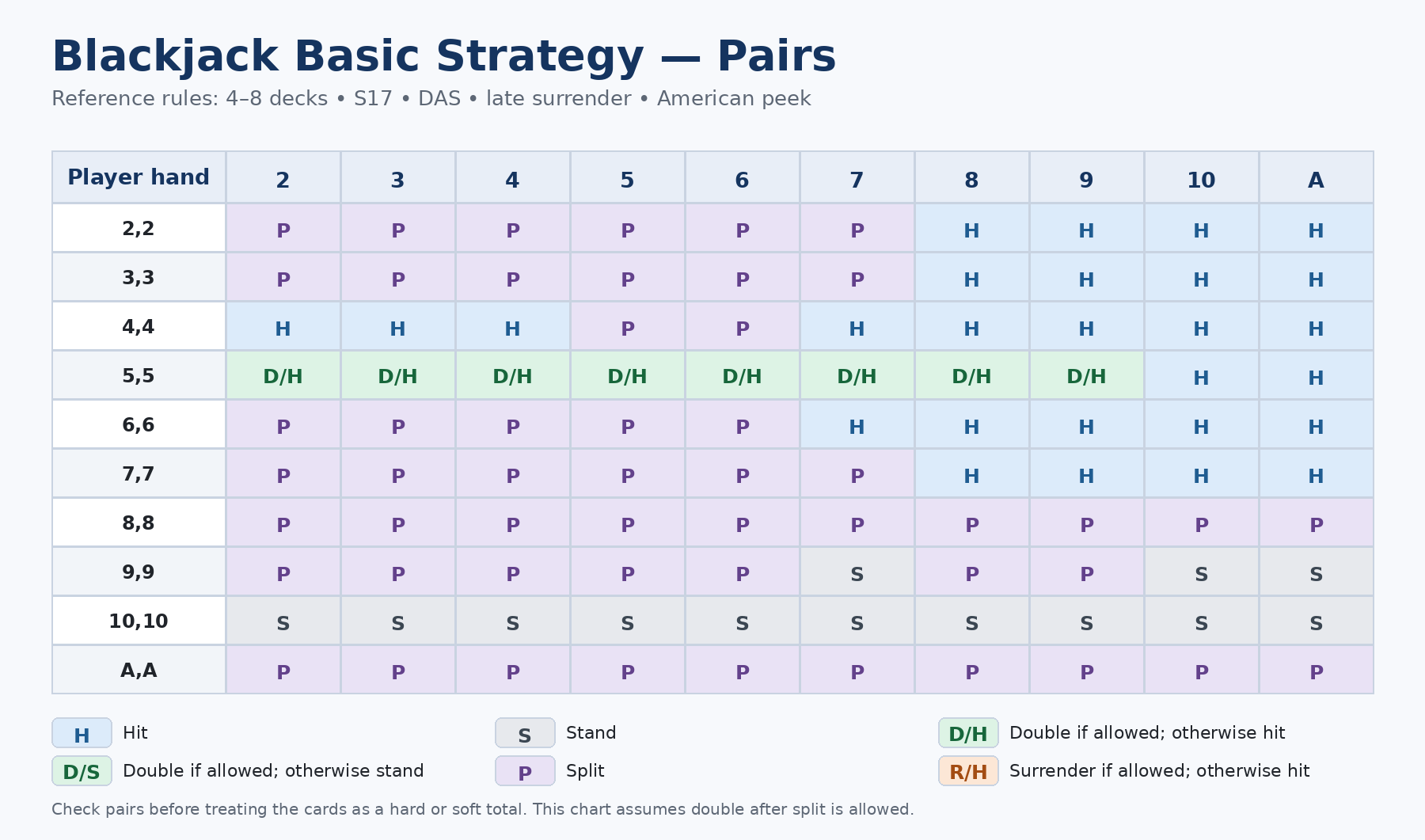
| Player pair | 2 | 3 | 4 | 5 | 6 | 7 | 8 | 9 | 10 | A |
|---|---|---|---|---|---|---|---|---|---|---|
| 2,2 | P | P | P | P | P | P | H | H | H | H |
| 3,3 | P | P | P | P | P | P | H | H | H | H |
| 4,4 | H | H | H | P | P | H | H | H | H | H |
| 5,5 | D/H | D/H | D/H | D/H | D/H | D/H | D/H | D/H | H | H |
| 6,6 | P | P | P | P | P | H | H | H | H | H |
| 7,7 | P | P | P | P | P | P | H | H | H | H |
| 8,8 | P | P | P | P | P | P | P | P | P | P |
| 9,9 | P | P | P | P | P | S | P | P | S | S |
| 10,10 | S | S | S | S | S | S | S | S | S | S |
| A,A | P | P | P | P | P | P | P | P | P | P |
Pair strategy explained
Always split aces under the reference rules
Two aces form soft 12, a weak combined hand. Splitting creates two opportunities to begin with an ace.
A ten-value card dealt to a split ace normally creates 21 but is usually paid as an ordinary win, not as a 3:2 natural blackjack.
Split 8s under the reference S17 rules
A pair of 8s is hard 16, one of the weakest starting totals. Splitting does not guarantee a profit; it produces the least damaging available long-run action.
Under the S17 late-surrender chart on this page, split 8s against every dealer upcard, including an ace.
In an H17 game with late surrender, surrendering 8-8 against a dealer ace becomes the correct adjustment.
Never split 10s in ordinary basic strategy
A pair of ten-value cards forms 20, an exceptionally strong hand. Splitting replaces one strong hand with two incomplete hands.
Card counters can have rare index-based exceptions, but those do not belong in ordinary basic strategy.
Never split 5s
A pair of 5s is hard 10. Doubling that strong starting total against dealer 2 through 9 is more valuable than beginning two hands with a 5.
Split 9s selectively
Split 9s against dealer 2 through 6 and 8 or 9. Stand against 7, 10 and ace.
Against dealer 7, the unsplit total of 18 is already competitive. Against 10 or ace, splitting exposes twice the wager against a strong upcard without sufficient expected-value improvement.
Worked basic strategy examples
8-4 against dealer 5
- Not a pair
- No usable ace
- Hard 12 against 5
- Stand
5-5 against dealer 6
- Check the pair chart first
- Do not split 5s
- Treat as hard 10
- Double
A-2 against dealer 7
- Soft 13
- Hit
If a 4 arrives, the hand becomes soft 17 and is hit again against 7. If a ten then arrives, it becomes hard 17 and stands.
10-6 against dealer 10
- Hard 16
- Late surrender is available under the reference rules
- Surrender
If surrender is unavailable, hit.
8-8 against dealer ace
- Check the pair chart
- Reference game is S17
- Split
Do not treat the pair as an ordinary hard 16. In H17 with late surrender, this becomes a surrender adjustment.
A-7 against dealer 6
- Soft 18
- Double if allowed
- If doubling is unavailable, stand
9-9 against dealer 7
- Pair of 9s
- Pair chart says stand
- Stand on 18
Late surrender strategy
Late surrender allows the player to forfeit half the original wager after the dealer has checked for blackjack or under an equivalent procedure.
Under the reference S17 game:
- Surrender hard 16 against dealer 9, 10 or ace.
- Do not surrender a pair of 8s; split it.
- Surrender hard 15 against dealer 10.
When surrender is unavailable:
- Hit hard 16 against 9, 10 or ace.
- Hit hard 15 against 10.
H17 surrender additions
When the dealer hits soft 17 and late surrender is available, add:
- Surrender hard 15 against dealer ace.
- Surrender hard 17 against dealer ace.
- Surrender 8-8 against dealer ace instead of splitting.
Surrender strategy changes under early surrender and European procedures. Confirm the exact rule rather than relying only on the word “surrender.”
Insurance and even money
Insurance is a separate wager that the dealer has a ten-value hole card when showing an ace.
Under ordinary basic strategy:
Do not take insurance.
The offered 2:1 payout is below the fair price when the undealt cards have their normal composition.
“Even money” on a player blackjack is mathematically equivalent to insuring the blackjack for the maximum amount. A non-counter following basic strategy should decline even money and accept the normal settlement.
A trained card counter can take insurance when the remaining deck is sufficiently rich in tens. That is a count-based deviation, not basic strategy.
How strategy changes when the dealer hits soft 17
H17 means the dealer must draw another card with a soft total of 17, such as ace-6.
Starting with the reference S17 chart, the important 4–8 deck H17 changes are:
| Hand | Dealer | S17 action | H17 action |
|---|---|---|---|
| Hard 11 | Ace | Hit | Double if allowed; otherwise hit |
| Soft 18, A-7 | 2 | Stand | Double if allowed; otherwise stand |
| Soft 19, A-8 | 6 | Stand | Double if allowed; otherwise stand |
| Hard 15 | Ace | Hit | Surrender if allowed; otherwise hit |
| Hard 17 | Ace | Stand | Surrender if allowed; otherwise stand |
| 8-8 | Ace | Split | Surrender if allowed; otherwise split |
H17 is less favorable to the player than an otherwise identical S17 game.
How strategy changes when DAS is not allowed
DAS means the player may double a hand created after splitting.
When DAS is prohibited, several marginal splits become hits because the new hands lose valuable doubling opportunities.
| Pair | Dealer upcard | With DAS | Without DAS |
|---|---|---|---|
| 2-2 | 2 or 3 | Split | Hit |
| 3-3 | 2 or 3 | Split | Hit |
| 4-4 | 5 or 6 | Split | Hit |
| 6-6 | 2 | Split | Hit |
The remaining pair decisions on the reference chart generally stay the same.
Single-deck and double-deck strategy
Do not apply the 4–8 deck chart as a perfect single-deck chart.
Removing one card has a larger effect in a smaller deck supply, which changes several close doubles and splits.
Examples of common single-deck differences can include:
- Doubling hard 8 against dealer 5 or 6
- Doubling hard 9 against dealer 2
- Doubling hard 11 against dealer ace under some S17 single-deck rules
- Additional soft-double changes
The exact chart still depends on S17/H17, DAS, surrender and dealer peek.
Use a dedicated single-deck blackjack strategy or a rule-specific calculator rather than memorizing a partial adjustment list.
American peek versus European no-hole-card blackjack
American peek
The dealer normally receives a hole card at the beginning of the round and checks for blackjack when showing an ace or ten-value card.
Once the dealer confirms no blackjack, the player can split or double without those additional wagers later losing to an already completed dealer natural.
European no-hole-card
The dealer initially receives only the upcard and takes the second card after players complete their hands.
Under full European no-hole-card exposure, a later dealer blackjack can collect:
- The original wager
- Double-down wagers
- Additional split wagers
This changes selected splits and doubles against dealer 10 or ace.
Original bets only
Some no-hole-card games protect additional wagers and collect only the player’s original wager when the dealer later has blackjack.
This is commonly described as:
- OBO
- Original bets only
- Original wager only
OBO strategy is closer to American peek strategy than full ENHC exposure, but the game information remains controlling.
The 3:2 versus 6:5 blackjack payout
Basic strategy cannot compensate for a poor blackjack payout.
On a $20 original wager:
- 3:2 blackjack profit: $30
- 6:5 blackjack profit: $24
- Difference: $6 every time the player receives a qualifying natural
Changing the payout from 3:2 to 6:5 adds approximately 1.39 percentage points to the house advantage under standard assumptions.
That effect is larger than many of the strategy refinements players spend hours memorizing.
Before sitting down, read the felt or game information screen. Do not assume that a single-deck table pays 3:2.
Basic strategy for Spanish 21 and other variants
The former article advised avoiding Spanish 21 and Super Fun 21 because they were supposedly impossible to beat.
That is too broad.
These are separate games with different decks, payouts, bonus rules and optimal strategies. Their liberal player options are balanced by other changes, but their value cannot be judged by applying ordinary blackjack basic strategy.
For example, Spanish 21 removes all four tens from each deck but normally includes rules such as:
- Player 21 automatically winning
- Player blackjack beating dealer blackjack
- Late surrender
- Double after split
- Additional-card doubles in many versions
- Bonus payouts for selected hands
Use a dedicated strategy for any proprietary variation. Do not use the charts on this page for:
- Spanish 21
- Super Fun 21
- Free Bet Blackjack
- Blackjack Switch
- Double Exposure
- Blackjack variants with push-22 rules
- Charlie-rule games without recalculation
Basic strategy versus composition-dependent strategy
The charts on this page are primarily total dependent.
They consider:
- The player total
- Hard or soft status
- Pair status
- The dealer upcard
- The table rules
Composition-dependent blackjack strategy distinguishes the exact cards forming the total.
For example, 10-2 and 7-5 both total hard 12, but a single-deck composition calculation can play them differently against dealer 4.
The improvement is small and matters most in single deck. Master the standard chart before adding composition exceptions.
Basic strategy versus card counting
Basic strategy assumes no usable information about an unusual concentration of remaining cards beyond the current hand and standard rules.
Card counting tracks exposed cards and estimates how the remaining shoe differs from its starting composition.
A counter begins with basic strategy and then applies selected index deviations.
Examples can include:
- Taking insurance at a sufficiently high count
- Standing on 16 against 10 at a specified count
- Standing on 15 against 10 at a higher threshold
- Doubling selected hands at count-specific indices
Do not mix memorized card-counting deviations into ordinary play without maintaining the corresponding count accurately.
Basic strategy does not depend on your wager size
A correct decision does not become incorrect because the wager is larger than usual.
If doubling 11 against dealer 10 is correct with a $5 wager, it remains correct with a $500 wager under identical rules and card information.
Refusing the double because the amount feels uncomfortable means the starting wager was too large for the available bankroll or session budget.
Choose a blackjack table limit that leaves room for correct splits and doubles.
Do other players change your basic strategy?
No. Another player’s hit, stand or split does not change the chart you should use for an ordinary basic-strategy decision.
Their action changes which unknown card appears next, but neither player knew the card order in advance.
Do not:
- Stand because third base “took the dealer’s bust card” on the previous hand
- Hit because the table has lost several rounds
- Split to “change the flow”
- Alter a correct play to satisfy another player
The applicable hand, dealer upcard and rules remain the basis of the decision.
Seven-day basic strategy practice plan
Day 1: hard 12 through 16
Practice the main boundary:
- Hard 12 stands only against 4 through 6.
- Hard 13 through 16 stand against 2 through 6.
- Otherwise hit, subject to surrender.
Day 2: hard doubles
Drill:
- 9 doubles against 3 through 6.
- 10 doubles against 2 through 9.
- 11 doubles against 2 through 10 under S17.
Day 3: soft totals
Concentrate on:
- Soft 13–14 double against 5–6.
- Soft 15–16 double against 4–6.
- Soft 17 doubles against 3–6.
- Soft 18 stands against 2, 7 and 8; doubles 3–6; hits 9 through ace.
Day 4: pairs
Memorize the anchors:
- Always split aces.
- Split 8s under the reference S17 rules.
- Never split 5s or 10s.
- Split 9s against 2–6 and 8–9.
Day 5: surrender and rule recognition
Practice identifying:
- S17 or H17
- DAS or no DAS
- Late surrender or no surrender
- American peek, ENHC or OBO
Day 6: mixed timed decisions
Deal random player hands and dealer upcards. Make each decision within approximately ten seconds while maintaining accuracy.
Do not increase speed when errors rise.
Day 7: full-round simulation
Play at least 50 free hands without consulting the chart during the decision. Record every uncertain or incorrect play and drill those specific hands afterward.
Using a strategy card at the table
Many casinos permit players to consult a printed strategy card, but property policies and procedures vary.
A strategy card should:
- Match the table rules
- Remain on the player’s side of the layout
- Not interfere with cards, chips or dealing
- Be consulted without delaying the game excessively
Ask the dealer when uncertain. Do not assume that an electronic device may be used merely because a printed card is permitted.
Basic strategy in online blackjack
Online play can make strategy easier to apply because the screen normally displays:
- The player cards
- The dealer upcard
- Available actions
- The betting range
- Game rules and paytable
It can also produce new errors:
- Playing too quickly
- Misclicking hit or stand
- Assuming every provider uses the same rules
- Ignoring the blackjack payout
- Using an American chart for an ENHC game
- Playing several tables before decisions are automatic
Open the help screen and record the rules before selecting a chart.
Common blackjack basic strategy mistakes
Standing on hard 12 against dealer 2 or 3
Under the reference multi-deck chart, hit. Hard 12 stands only against 4 through 6.
Standing on soft 17
Hit or double according to the dealer upcard. Soft 17 is not an automatic stand.
Standing on soft 18 against 9, 10 or ace
Hit under the reference rules.
Splitting 5s
Treat them as hard 10 and double against dealer 2 through 9.
Refusing to split 8s because the dealer has a strong card
Under the S17 chart, split. Under H17 with surrender, 8-8 against ace is a specific surrender adjustment.
Surrendering every hard 16 automatically
Under the reference rules, surrender against 9, 10 or ace—not against every dealer card.
Using H17 changes in an S17 game
Doubling 11 against an ace and doubling soft 19 against 6 are H17 adjustments, not reference S17 actions.
Taking insurance to protect a strong hand
The value of insurance depends on the concentration of ten-value cards, not whether the player holds 20 or blackjack.
Changing strategy after losses
A losing streak does not alter the expected-value comparison for the next hand.
Using a 4–8 deck chart for single deck
Several doubles and close decisions change. Use a dedicated chart.
Ignoring the payout
Perfect strategy at a 6:5 table can still leave the player with a much worse game than 3:2 blackjack.
Frequently asked questions
What is blackjack basic strategy?
Blackjack basic strategy is the mathematically best hit, stand, double, split or surrender decision for a player hand against a dealer upcard under a defined set of table rules.
Does basic strategy guarantee that I will win?
No. It improves long-run expected return but cannot control the next card or prevent losing sessions.
Is there one blackjack strategy chart for every casino?
No. Strategy can change with deck count, S17 or H17, double-after-split rules, surrender, doubling restrictions and dealer hole-card procedures.
Should I always split aces and eights?
Under the reference S17 rules, split aces and eights against every dealer upcard. In an H17 game with late surrender, surrendering 8-8 against a dealer ace is a specific adjustment.
Should I hit or stand on hard 16 against dealer 10?
Surrender when late surrender is available. Otherwise hit under ordinary total-dependent basic strategy.
Should I hit soft 18 against dealer 10?
Yes. Under the reference rules, soft 18 hits against dealer 9, 10 or ace.
Should I take insurance?
Not under ordinary basic strategy. Insurance has negative expectation at normal deck composition. A trained counter can take it only when a count-based threshold is reached.
How much does basic strategy reduce the house edge?
The final house edge depends on the rules. Competitive 3:2 games can often be brought near the one-half-percent range, but weak rules such as 6:5 blackjack can make the edge much higher.
Can I use this chart in European blackjack?
Not perfectly when additional double and split wagers lose to a later dealer blackjack. European no-hole-card strategy requires rule-specific adjustments, especially against dealer 10 or ace.
How long does basic strategy take to learn?
Many players can learn the major patterns in several focused weeks. Reliable casino-speed accuracy requires repeated mixed-hand practice rather than only reading the chart.
Related CountingEdge guides
- Blackjack rules
- Blackjack strategy cheat sheet
- Blackjack Strategy Wizard
- When to hit or stand
- When to double down
- Blackjack pair splitting
- Splitting aces and eights
- Blackjack insurance
- Composition-dependent blackjack strategy
- Blackjack card counting
- Hi-Lo card counting
- Blackjack table layout
- Blackjack table limits
- European blackjack
- Free blackjack practice
Technical and regulatory sources
- Wizard of Odds: 4–8 deck blackjack basic strategy
- Wizard of Odds: rule-specific basic strategy calculator
- Wizard of Odds: blackjack house-edge calculator
- Wizard of Odds: mathematical effects of blackjack rule variations
- Wizard of Odds: single-deck basic strategy
- Wizard of Odds: double-deck basic strategy
- Wizard of Odds: European no-hole-card basic strategy
- Wizard of Odds: blackjack surrender rules and strategy
- QFIT: blackjack basic and count-based strategy families
- New Jersey blackjack equipment, payout and dealer-rule standards
- New Jersey authorized blackjack game procedures
Strategy note: the charts on this page apply only to the stated reference rules. Confirm the number of decks, S17 or H17, DAS, surrender, blackjack payout and hole-card procedure before using them.